

If you’ve ever walked through Istanbul and wondered how one city holds so many domes, palaces, and old stone walls, you’ve already brushed up against Ottoman Empire history. This guide walks you through it in plain, simple English, from a small Turkish tribe in Anatolia to a six-century empire that shaped three continents, and shows you where you can still stand inside that story today.
Understanding Ottoman Empire history isn’t just for scholars. It’s for anyone planning a trip to Turkey who wants their visit to mean something more than photos. Once you know the story behind Topkapi Palace or the Blue Mosque, the whole country reads differently.
What Was the Ottoman Empire?
The Ottoman Empire was one of the longest-lasting and most powerful empires in world history. It began in the late 13th century in northwestern Anatolia and eventually stretched across parts of Europe, Asia, and Africa.
At its peak, this empire controlled territory from the gates of Vienna to the shores of North Africa, and from the Balkans to the Persian Gulf. Any serious look at Ottoman Empire history has to start with how unusual this reach was for its time, connecting so many different peoples, languages, and religions under one ruling system.
The empire lasted for more than 600 years, from 1299 to 1922, making it one of the most durable political structures the world has seen.
Origins of the Ottoman Empire
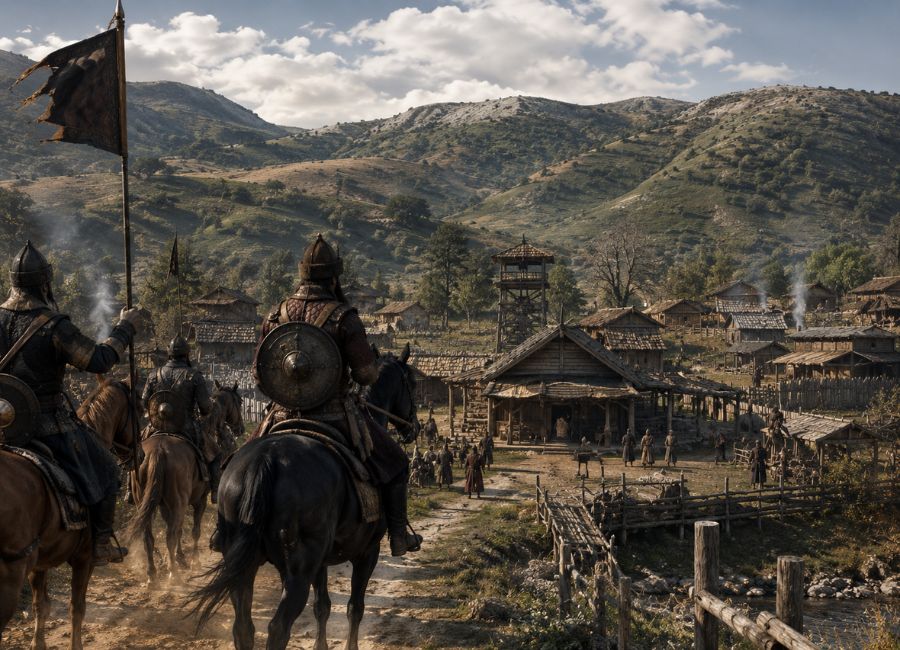
The roots of Ottoman Empire history trace back to a small Turkish beylik, or principality, in the region of Sogut in northwestern Anatolia. This area sat close to the crumbling edges of the Byzantine Empire, which gave the early Ottomans both opportunity and constant conflict.
Anatolia in the late 1200s was a patchwork of small Turkish states competing with one another and with Byzantine forces. Out of this competitive environment, one group under a leader named Osman began to rise above the rest.
Who Founded the Ottoman Empire?
The empire takes its name from its founder, Osman I, who ruled the small beylik starting around 1299. This date is generally accepted as the formal beginning of Ottoman Empire history.
Osman I expanded his territory by absorbing nearby lands and forming alliances with other Turkish groups. His son, Orhan, continued this work and captured the city of Bursa, which became the first real Ottoman capital.
The Osman dynasty that followed would rule continuously until the empire’s end in the 20th century, an unusually long unbroken line of succession for any royal family.
Early Expansion
After Bursa, Ottoman forces pushed further into Byzantine territory and crossed into Europe for the first time in the 1350s. This crossing into the Balkans marked a turning point in Ottoman Empire history, since it meant the empire was no longer confined to Anatolia.
Key early gains included:
- Gallipoli, the first Ottoman foothold in Europe
- Adrianople, later renamed Edirne, which became a new capital
- Much of the Balkan Peninsula, including parts of modern Serbia, Bulgaria, and Greece
By the early 1400s, the Ottomans controlled a large stretch of territory on both sides of the Bosphorus, encircling what remained of the Byzantine Empire.
Capture of Constantinople
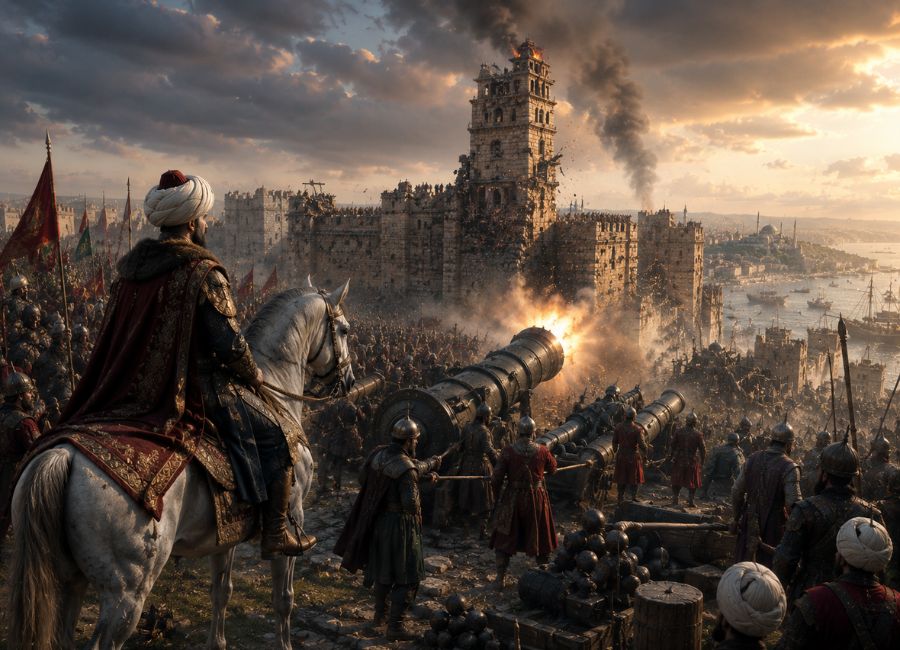
No single event carries more weight than the fall of Constantinople in 1453. Sultan Mehmed II, later known as Mehmed the Conqueror, led a siege against the ancient Byzantine capital using massive cannons designed specifically to break its legendary walls.
The city had resisted sieges for over a thousand years, protected by triple layers of land walls that had defeated Arab armies, crusaders, and countless other invaders. Mehmed II, only 21 years old at the time, brought in Hungarian cannon engineer Orban to build siege guns large enough to finally crack those defenses, a decision that changed the course of the campaign.
After weeks of siege, the city fell on May 29, 1453. Mehmed II renamed it Istanbul and made it the new Ottoman capital, a role the city has held in various forms ever since.
This conquest ended the Byzantine Empire completely and gave the Ottomans control of a critical trade route between Europe and Asia. It also gave the sultans a symbolic claim as heirs to the old Roman imperial tradition.
Why Constantinople Mattered to Ottoman Empire History
Taking Constantinople wasn’t just a military win. It gave the Ottomans a natural capital sitting between two continents, with a harbor that made trade and naval power possible on a scale few empires ever reached.
The Golden Age Under Suleiman the Magnificent
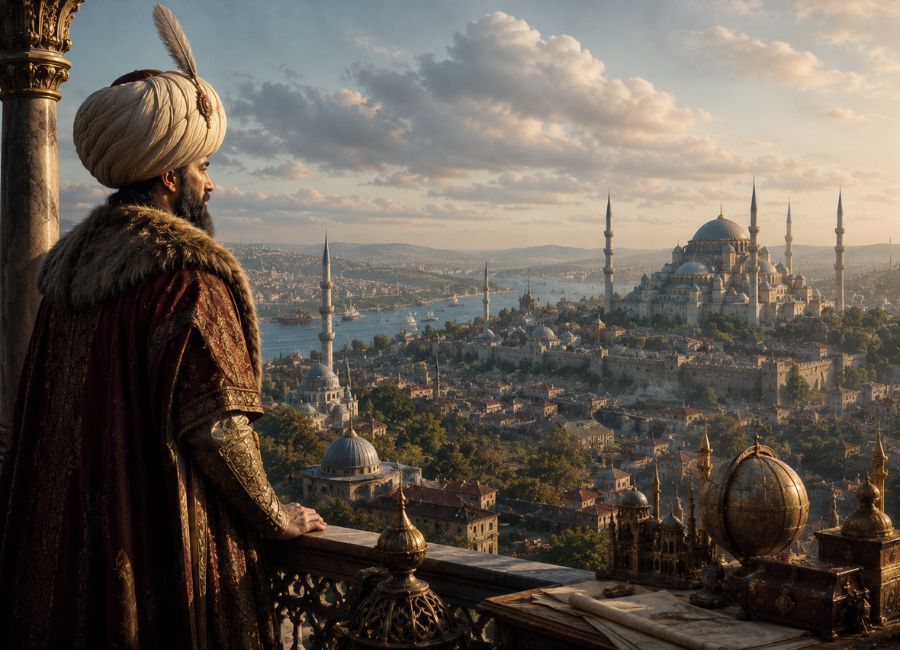
Many historians consider the reign of Suleiman the Magnificent, from 1520 to 1566, the high point of Ottoman Empire history. Under Suleiman, the empire reached its greatest territorial size, stretching from Hungary to the Arabian Peninsula.
Suleiman was known in the West as “the Magnificent” for his wealth and building projects, and in the Ottoman world as “Kanuni,” meaning “the Lawgiver,” for his legal reforms. He reorganized the legal system, supported the arts, and commissioned some of the finest architecture in Istanbul, including work by the great architect Mimar Sinan.
Trade flourished, the military expanded, and Istanbul grew into one of the largest and richest cities on earth during this period.
Government and Administration
The Ottoman state was organized around the sultan, who held both political and, after the 16th century, religious authority as caliph. Below the sultan, a grand vizier managed day-to-day government affairs, while an imperial council called the Divan handled major decisions on law, taxation, and foreign policy.
Provinces were run by governors who answered directly to Istanbul, and a professional bureaucracy of scribes and judges, trained in Islamic law and administrative practice, kept the vast territory functioning. This layered structure allowed the empire to govern regions thousands of miles apart with a surprising degree of consistency.
The empire used a system called the millet system to govern its many religious communities. Under this system, Christian, Jewish, and Muslim communities managed their own internal legal and religious matters while paying taxes and remaining loyal to the sultan.
This flexible approach to governing diverse populations is a key reason Ottoman Empire history includes such a wide range of cultures living together, often more peacefully than in many contemporary European states.
Military System
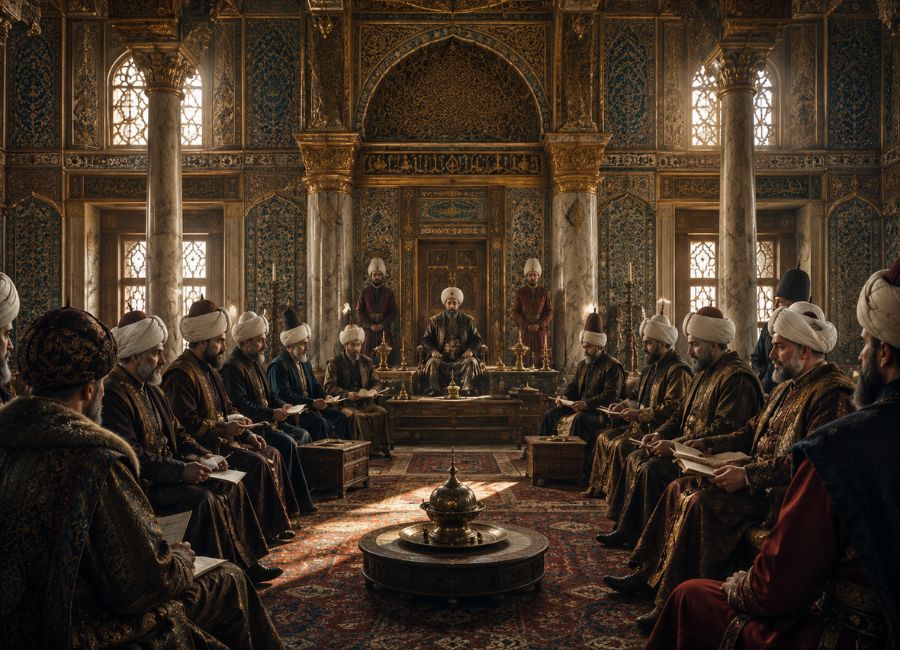
Ottoman military strength rested on several pillars. The most famous was the Janissary corps, an elite infantry force originally recruited through a system called devshirme, which took young boys from Christian families in the Balkans and trained them for military or administrative service.
Janissaries lived in barracks, followed strict discipline, and for centuries were forbidden to marry, which kept their loyalty focused entirely on the sultan rather than on family or local interests. Over time, this corps became one of the most effective standing armies in the world, feared across both Europe and the Middle East.
Other elements included:
- Timariot cavalry, land-holding soldiers who served in exchange for territory
- A powerful navy that controlled much of the Mediterranean at its height
- Advanced artillery units, including the massive cannons used at Constantinople
- Irregular light cavalry units used for scouting and rapid raids on enemy territory
This military system made the Ottomans one of the most feared powers in Europe and the Middle East for centuries.
Economy and Trade
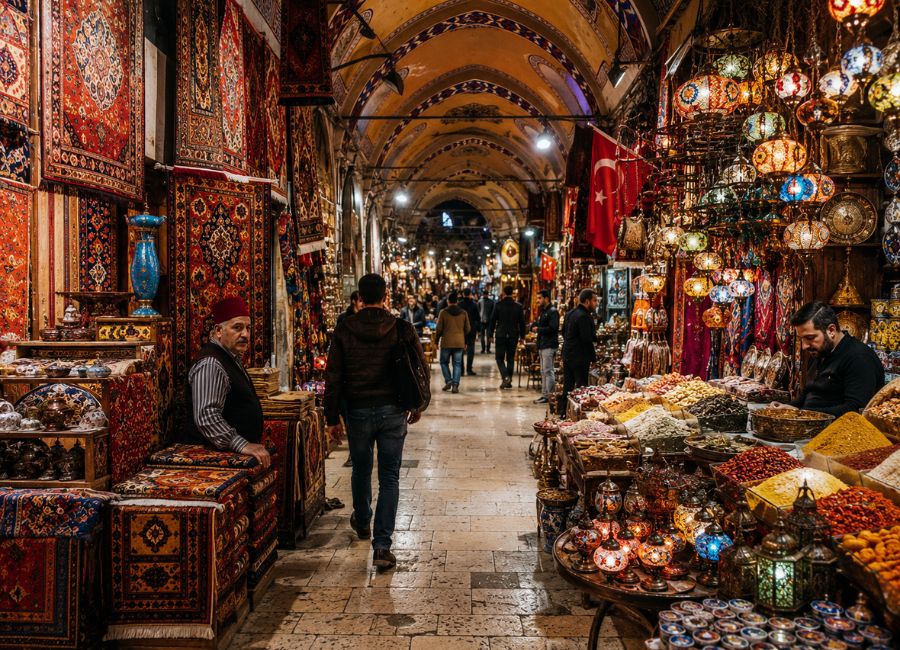
Sitting at the crossroads of Europe and Asia gave the empire enormous economic advantages. Istanbul, along with cities like Bursa and Izmir, became major trading hubs connecting the Silk Road to Mediterranean and European markets.
The Grand Bazaar in Istanbul, one of the oldest covered markets in the world, symbolizes this trading tradition and still operates today. Agriculture, textiles, and craft production also formed a major part of the Ottoman economy, supporting a population that grew steadily during the empire’s stronger centuries.
Taxation played a central role in funding the state. Non-Muslim subjects typically paid a special tax called the jizya, while land taxes and customs duties on trade goods passing through Ottoman ports filled the imperial treasury. Guilds regulated craftsmen and merchants in most major cities, setting prices and quality standards that kept commerce orderly across the empire.
Religion and Society
Islam was the state religion, and the sultan held the title of caliph from the 16th century onward, giving him religious authority over Sunni Muslims. However, the empire was home to large Christian and Jewish populations as well.
Society was structured around religious community rather than ethnicity in many cases. This structure shaped daily life, legal matters, and even taxation, and it remains one of the more distinctive features that students of the region’s past often find surprising.
Jewish communities, including many who fled persecution in Spain during the late 15th century, found relative tolerance under Ottoman rule and settled in cities such as Istanbul and Thessaloniki, where they built lasting communities that lasted for centuries.
Culture, Art, and Architecture
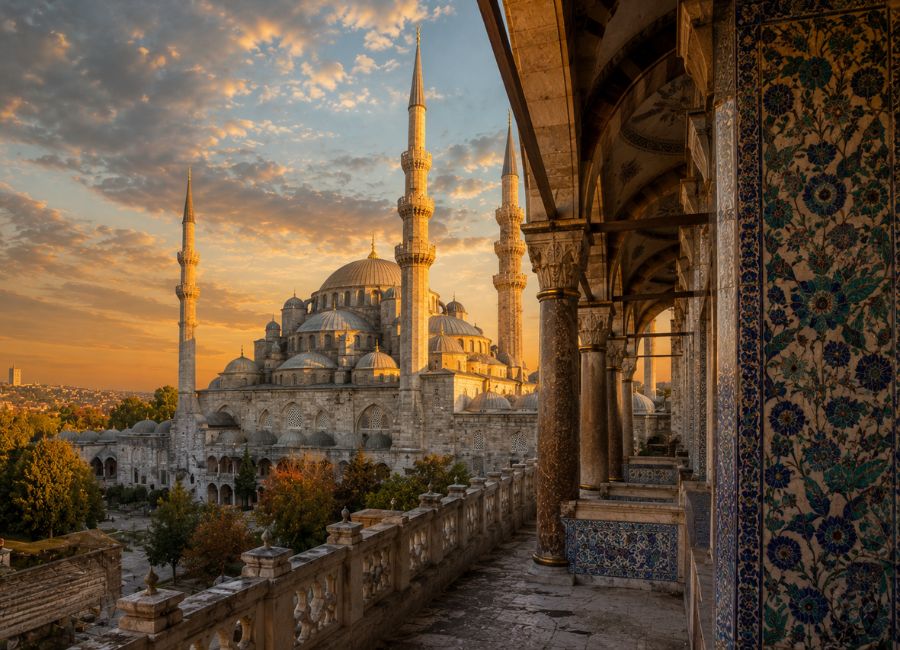
Ottoman architecture blended Islamic, Byzantine, and Persian influences into a distinct style recognized around the world. Domes, minarets, and courtyards define mosques like the Suleymaniye Mosque and the later Blue Mosque.
The architect Mimar Sinan, who worked mainly during Suleiman’s reign, designed hundreds of buildings, including mosques, bridges, and schools, many of which still stand.
Beyond architecture, Ottoman culture produced rich traditions in:
- Calligraphy and manuscript illumination
- Miniature painting
- Carpet weaving
- Ceramic art, especially Iznik tiles
- Classical Ottoman music and poetry
Daily Life in the Ottoman Empire
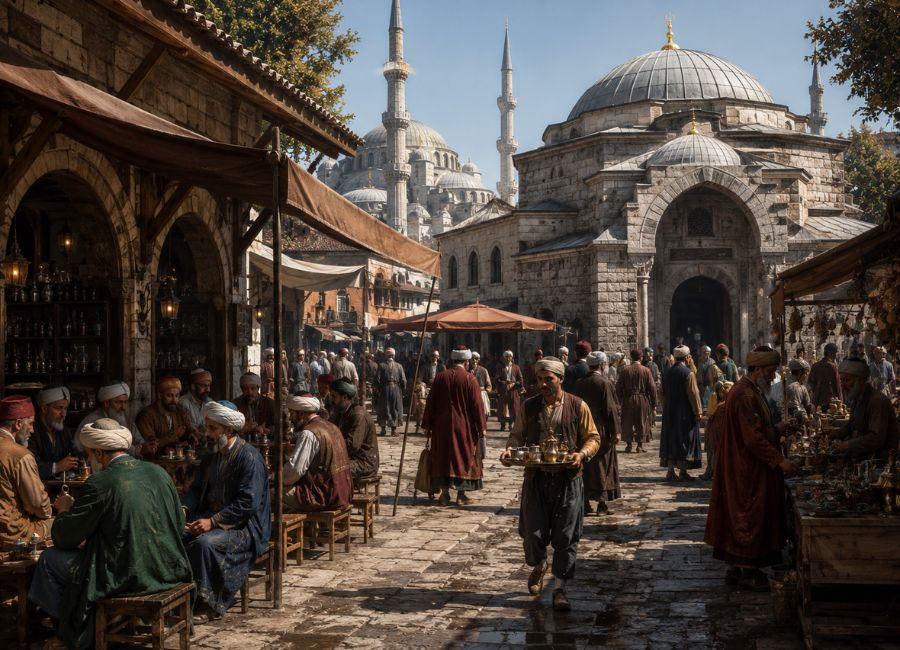
Daily life varied enormously depending on class, religion, and region. In cities, most people worked in trade, craft guilds, or government service. Rural populations largely farmed land, often under systems tied to the timar military structure.
Bazaars, mosques, bathhouses called hammams, and coffee houses formed the center of social life in Ottoman cities. Coffee itself became so popular in Ottoman society that Istanbul is often credited with helping introduce coffee culture to Europe.
Family life centered on the household, with extended families often living together and neighborhood ties playing a strong role in daily support and social order. Clothing, food, and even the layout of homes often reflected a family’s religion, profession, and standing within the community, giving Ottoman cities a visibly layered social fabric.
Education and Science
The Ottomans built a network of religious schools called madrasas, which taught theology, law, and sciences such as astronomy and mathematics. Istanbul also housed libraries, observatories, and hospitals that were advanced for their era.
Ottoman scholars contributed to medicine, geography, and engineering, and the empire’s mapmakers, such as Piri Reis, produced remarkably detailed world maps that still interest historians today. Hospitals attached to large mosque complexes, known as darüşşifa, offered free treatment to the public and trained physicians using both Islamic and classical Greek medical texts, an approach that kept Ottoman medicine relatively advanced well into the early modern period.
Famous Ottoman Sultans
Several sultans stand out across Ottoman Empire history for their impact on the empire’s direction.
| Sultan | Reign | Known For |
| Osman I | 1299–1324 | Founder of the dynasty |
| Mehmed II | 1444–1446, 1451–1481 | Conquered Constantinople |
| Selim I | 1512–1520 | Expanded into the Middle East and North Africa |
| Suleiman the Magnificent | 1520–1566 | Empire’s golden age, legal reforms |
| Abdul Hamid II | 1876–1909 | Late reforms and centralized rule |
| Mehmed VI | 1918–1922 | Last Ottoman sultan |
Major Wars and Conflicts
Warfare shaped much of Ottoman Empire history. Key conflicts include the Siege of Vienna in 1529 and again in 1683, both of which marked the empire’s furthest reach into Central Europe and ultimately ended in Ottoman withdrawal.
Later conflicts, including repeated wars with Russia and the Balkan Wars of 1912-1913, steadily reduced Ottoman territory in Europe. World War I proved decisive, as the empire fought alongside Germany and Austria-Hungary and ultimately ended up on the losing side.
Decline of the Ottoman Empire
The decline of the empire was gradual, unfolding over more than two centuries. Military defeats, territorial losses, and growing nationalist movements among subject peoples all played a role.
Contributing factors included:
- Repeated wars that drained state finances
- Rising nationalism in the Balkans and Arab provinces
- Slower adoption of industrial and military technology compared to Europe
- Internal power struggles among sultans, viziers, and reform movements
Reform efforts, known as the Tanzimat reforms, tried to modernize the empire’s legal, military, and administrative systems during the 19th century, with mixed success.
Fall of the Ottoman Empire
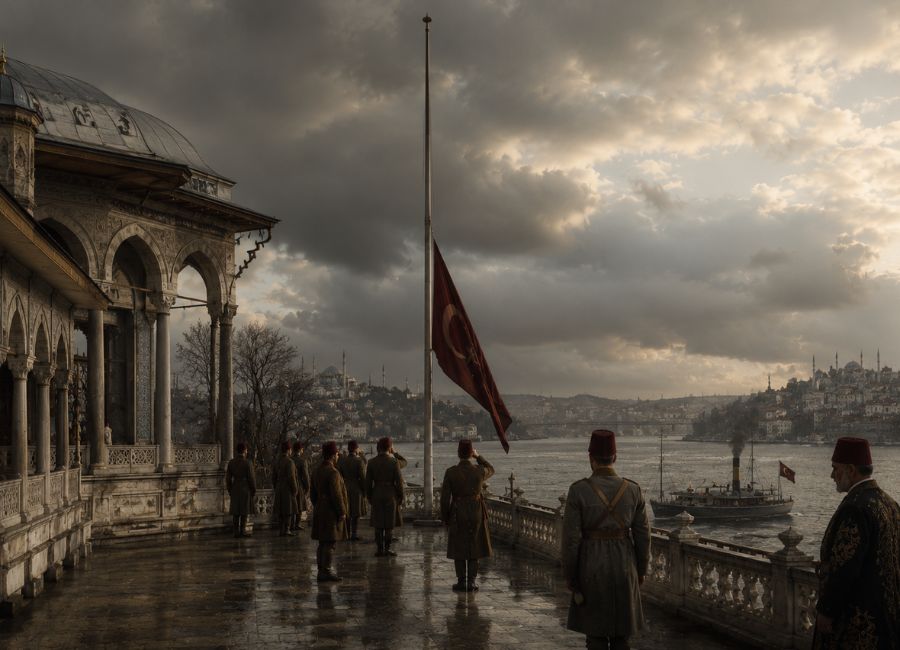
The empire’s final collapse came after World War I. Having fought on the losing side, the Ottomans faced occupation and the partitioning of their remaining territory by the victorious Allied powers.
A national resistance movement led by Mustafa Kemal Ataturk fought back against occupation and partition. In 1922, the sultanate itself was abolished, and in 1923 the Republic of Turkey was formally established with Ataturk as its first president.
This marked the official end of Ottoman Empire history as a political entity, closing a chapter that had lasted more than six centuries.
Legacy of the Ottoman Empire
The influence of the empire is still visible across the modern Middle East, Balkans, and North Africa, in borders, legal traditions, architecture, and cuisine. Modern Turkey inherited much of its cultural identity, along with cities full of Ottoman-era landmarks, from this long history.
Words, foods, and even coffee-drinking habits that spread from Ottoman lands still show up across the Balkans and the Middle East today. Cities such as Sarajevo, Sofia, and Thessaloniki still carry Ottoman-era mosques, bridges, and bazaars in their old town centers, a reminder that this empire’s reach went far beyond present-day Turkey.
Studying Ottoman Empire history helps explain many present-day political boundaries and cultural connections across a huge region, from Bosnia to Egypt.
How Travelers Can Explore Ottoman History Today
For travelers, Turkey remains the best place on earth to experience Ottoman Empire history firsthand. Istanbul alone holds centuries of palaces, mosques, and markets that are open to visitors year-round.
Top Ottoman Historical Places in Istanbul
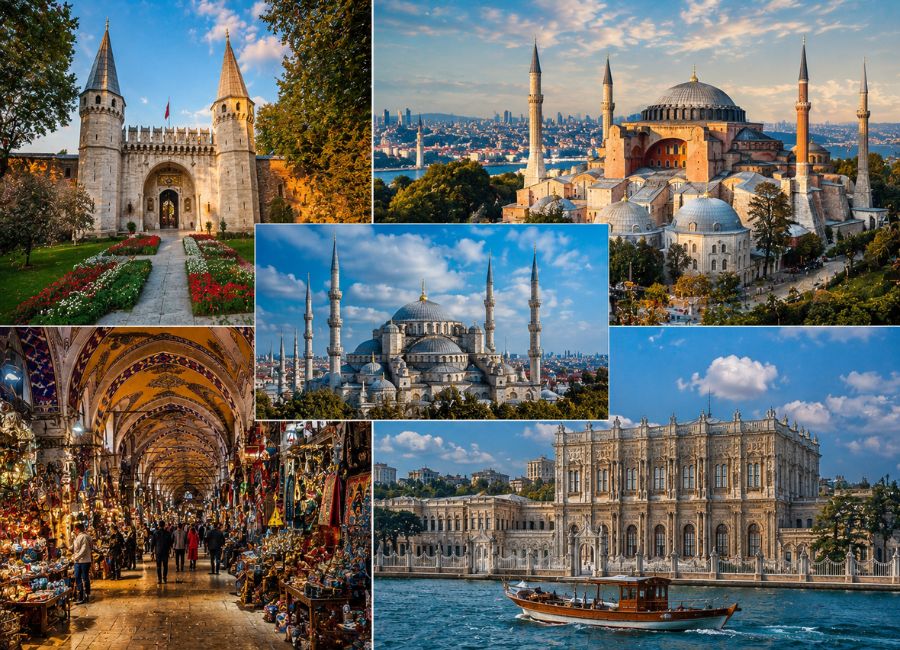
- Topkapi Palace, home to Ottoman sultans for nearly 400 years
- Blue Mosque (Sultan Ahmed Mosque)
- Hagia Sophia, spanning Byzantine and Ottoman history
- Grand Bazaar, one of the world’s oldest covered markets
- Dolmabahce Palace, a later, more European-style imperial residence
Top Ottoman Heritage Sites Elsewhere in Turkey
- Bursa, the empire’s first capital, with early sultan tombs
- Edirne, home to the Selimiye Mosque, considered Sinan’s masterpiece
- Konya, tied to Ottoman-era Sufi tradition
- Safranbolu, known for preserved Ottoman-era houses
Museums, Mosques, Palaces, and Castles Worth Visiting
- Istanbul Archaeology Museums
- Rumeli Fortress, built before the conquest of Constantinople
- Suleymaniye Mosque and its surrounding complex
- Anadolu Hisari, an early Ottoman fortress on the Bosphorus
Historic Bazaars
- Grand Bazaar, Istanbul
- Spice Bazaar (Egyptian Bazaar), Istanbul
- Koza Han, a historic silk market in Bursa
Travel Tips for History Lovers
- Book Topkapi Palace and Hagia Sophia tickets online in advance
- Hire a licensed local guide for deeper context at major sites
- Dress modestly when visiting active mosques
- Wear comfortable shoes; many historic sites involve cobblestones and stairs
- Visit early morning to avoid crowds at popular landmarks
Best Time to Visit Historical Sites
Spring (April to May) and early autumn (September to October) offer mild weather and smaller crowds, making these the best seasons for exploring Ottoman heritage sites in Istanbul and beyond.
Suggested One-Day Ottoman Heritage Itinerary
- Morning: Topkapi Palace and its harem quarters
- Late morning: Hagia Sophia
- Midday: Lunch near Sultanahmet Square
- Afternoon: Blue Mosque, followed by the Grand Bazaar
- Evening: Bosphorus walk near Dolmabahce Palace
If you’re planning a longer trip, check out our 7-Day Turkey Itinerary to explore Istanbul, Cappadocia, and other must-visit destinations.
Ottoman Empire Timeline
| Year | Event |
| 1299 | Osman I founds the Ottoman beylik |
| 1326 | Bursa becomes the first Ottoman capital |
| 1453 | Mehmed II conquers Constantinople |
| 1520–1566 | Reign of Suleiman the Magnificent |
| 1683 | Second Siege of Vienna fails |
| 1839–1876 | Tanzimat reform period |
| 1914–1918 | Ottoman Empire fights in World War I |
| 1922 | Sultanate abolished |
| 1923 | Republic of Turkey founded |
Key Facts About Ottoman Empire History
- Founded in 1299 by Osman I in northwestern Anatolia
- Lasted over 600 years, ending in 1922
- Capital moved from Bursa to Edirne, then to Istanbul after 1453
- At its height, controlled territory across three continents
- Ruled by a single dynasty, the House of Osman, for its entire existence
Interesting Facts
- The Ottoman navy once controlled most of the Mediterranean coastline
- Istanbul’s Grand Bazaar has over 4,000 shops and dates to the 15th century
- Coffee houses first became widely popular in Ottoman Istanbul before spreading to Europe
- Sultan Suleiman’s reign overlapped with the height of the Renaissance in Europe
- The Ottoman Empire was sometimes called “the sick man of Europe” in its final century
Mistakes Tourists Should Avoid
- Skipping advance tickets and waiting in long lines at major sites
- Wearing inappropriate clothing when entering active mosques
- Rushing through Topkapi Palace without allowing at least two to three hours
- Ignoring Bursa and Edirne, which offer quieter but equally rich Ottoman history
- Assuming all Ottoman sites are only in Istanbul
Conclusion
Ottoman Empire history is really the story of how a small Anatolian principality grew into one of the most influential empires the world has known, shaping culture, religion, and politics across three continents for over six centuries. From Osman I’s small beylik to Mehmed II’s conquest of Constantinople and Suleiman’s golden age, this is a history full of ambition, conflict, and remarkable achievement.
For travelers, the good news is that this history hasn’t disappeared into books alone. Walking through Topkapi Palace, standing under the domes of the Blue Mosque, or wandering the Grand Bazaar puts you directly inside Ottoman Empire history, not just reading about it. Whether you’re planning your first trip to Istanbul or your fifth, understanding this history turns every mosque, palace, and market into something far more meaningful.
FAQs
What is the Ottoman Empire history?
Ottoman Empire history covers more than 600 years of rule by the House of Osman, from a small Anatolian principality in 1299 to a vast empire spanning three continents, ending in 1922.
Why did the Ottoman Empire fall?
A combination of military defeats, territorial losses, rising nationalism, and the aftermath of World War I led to the empire’s collapse and the abolition of the sultanate in 1922.
How long did the Ottoman Empire last?
The empire lasted approximately 623 years, from 1299 to 1922, making it one of the longest-ruling dynasties in world history.
Who was the greatest Ottoman sultan?
Suleiman the Magnificent is widely considered the greatest sultan, presiding over the empire’s largest territorial extent and its cultural golden age.
Where can tourists experience Ottoman history in Turkey?
Istanbul offers the richest concentration of sites, including Topkapi Palace, the Blue Mosque, and the Grand Bazaar, while Bursa and Edirne offer quieter but historically significant Ottoman landmarks.